
What is the Pelvic Floor?
The pelvic floor is a group of muscles and ligaments that form a supportive sling at the base of your pelvis. These muscles help hold your pelvic organs — including the bladder, uterus, vagina, and bowel — in the correct position.
The muscles work with ligaments to support your organs, especially during activities that increase pressure in the tummy, like lifting, bending, or straining. This pressure is called intra-abdominal pressure. When it rises, your pelvic floor and tummy (abdominal) muscles tighten to help protect the organs.
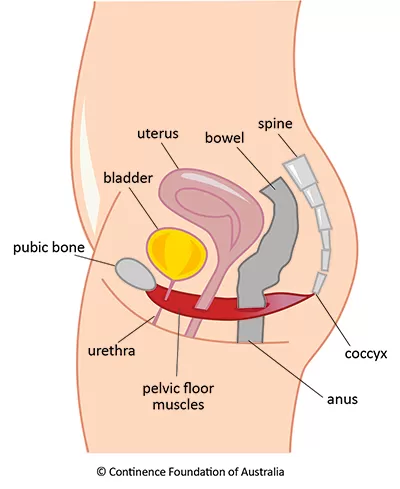
Functions of the Pelvic Floor:
- Help control the bladder and bowel, preventing leakage (incontinence)
- Relax to allow easy bladder and bowel emptying
- Play a role in healthy body changes, including sexual development later in life.
- Support your posture and spine alongside the tummy (abdominal) muscles.
Not all pelvic floor symptoms are due to weakness — some girls and women, need to learn how to engage and use these muscles correctly.
Like any muscle, the pelvic floor needs regular activation and strength to function well.
This content is based on resources provided by the Pelvic, Obstetric and Gynaecological Physiotherapy (POGP). It has been summarised and rephrased for educational purposes only. For the full, official guidelines, please visit the POGP website at https://thepogp.co.uk/_userfiles/pages/files/resources/20818_pogp_pelvicfloor_for_women_signed_off_1.pdf.
Note: Certain terminology has been adapted to ensure age appropriateness.